
Widening the road to four lanes is expected to have various benefits, including reducing traffic congestion, decreasing traffic accidents, ensuring transportation during large-scale disasters, and securing road space and traffic during heavy snowfall.
Reduced congestion

Reduction in traffic accidents

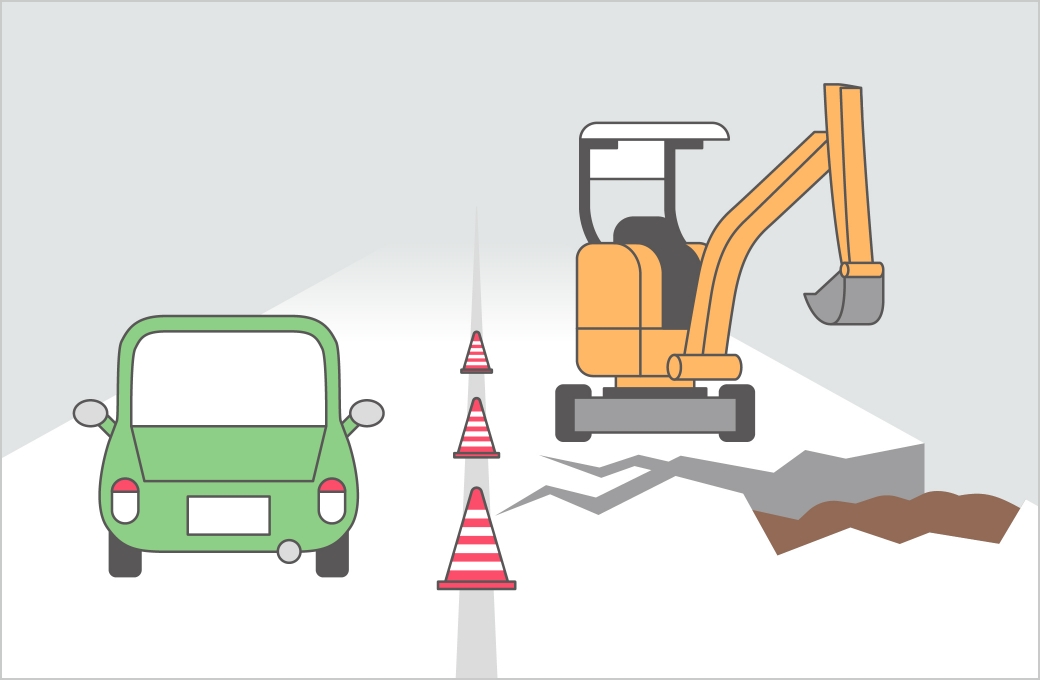
Securing transportation during large-scale disasters
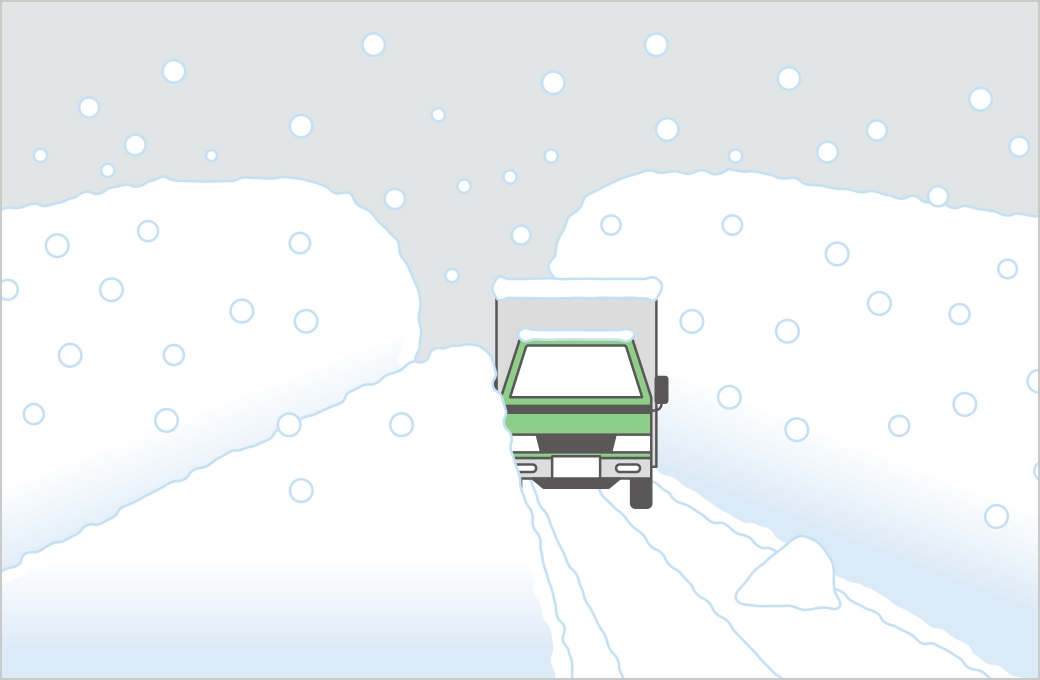
Ensuring road space and traffic during heavy snowfall
Doto Expressway becomes a "road of life."
The devastating damage caused by Typhoon No. 10 in 2016 and the efforts to recover.
Record-breaking heavy rains have cut off major roads connecting eastern and central Hokkaido.
On August 30, 2016, due to record-breaking heavy rains caused by Typhoon No. 10, National Route 274 (Nissho Pass), National Route 38 (Karikachi Pass), prefectural roads, and JR railway lines suffered damage such as mudslides, road collapses, and bridge collapses, rendering them impassable for an extended period.
Additionally, damage occurred on Doto Expressway (Doto Expressway), resulting in a road closure between Shimukappu IC and Memuro IC.
- August 29, 2016 (Monday) 21:55 Tomamu IC to Tokachi Shimizu IC road closed (pre-emptive road closure due to rain forecast)
- August 30, 2016 (Tuesday) 15:35 Extended road closure section between Shimukappu IC and Tokachi Shimizu IC
- August 31, 2016 (Wed) 0:54 The section of road closure between Shimukappu IC and Memuro IC has been extended.
- August 31, 2016 (Wed) 7:20 AM: Road closure between Shimukappu IC and Memuro IC changed (Rainfall/Poor Visibility → Road closure due to disaster)
- September 1, 2016 (Thursday) 8:00 AM: The road closure between Shimukappu IC and Memuro IC has been lifted.
Rapid restoration of Doto Expressway, road closure lifted in approximately one day.
Doto Expressway also suffered extensive damage, with the Karikachi No. 2 Tunnel being particularly severely affected, as a large amount of soil and water flowed in, burying more than half of the Obihiro-side entrance.
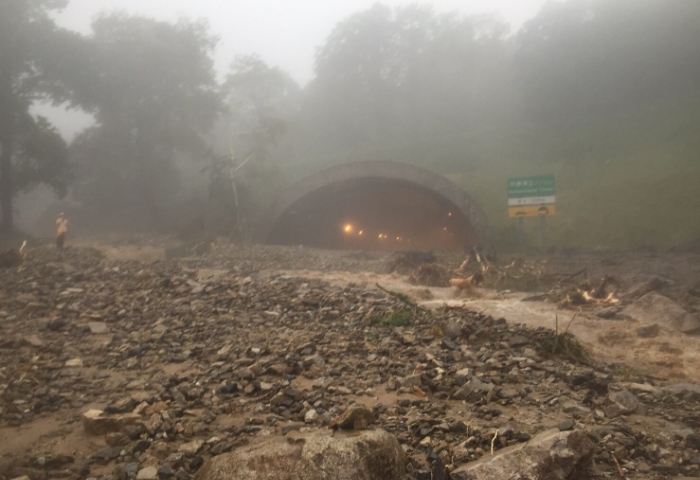
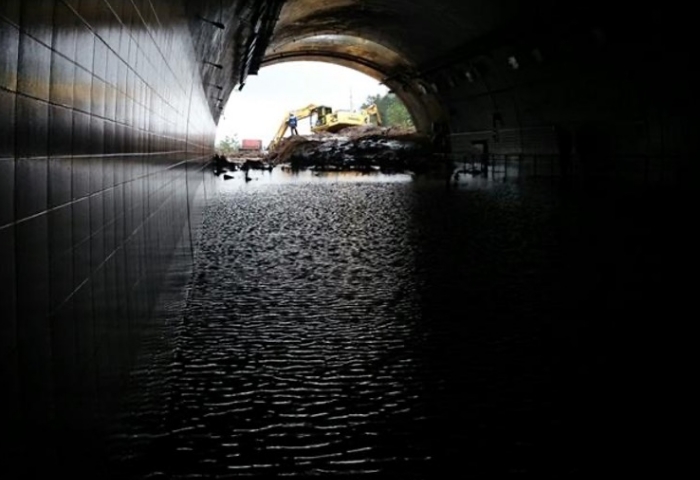
August 31, 2016 | 7:20 AM |Damage situation near the Obihiro-side entrance of the Karikachi No. 2 Tunnel and inside the tunnel.
While bridge collapses, road damage, and embankment collapses occurred on parallel national and prefectural roads, prolonging restoration work, large sandbags were installed to prevent soil and debris from flowing onto the main Doto Expressway, and the removal of soil and debris from the main road was given top priority to secure space for vehicle traffic.
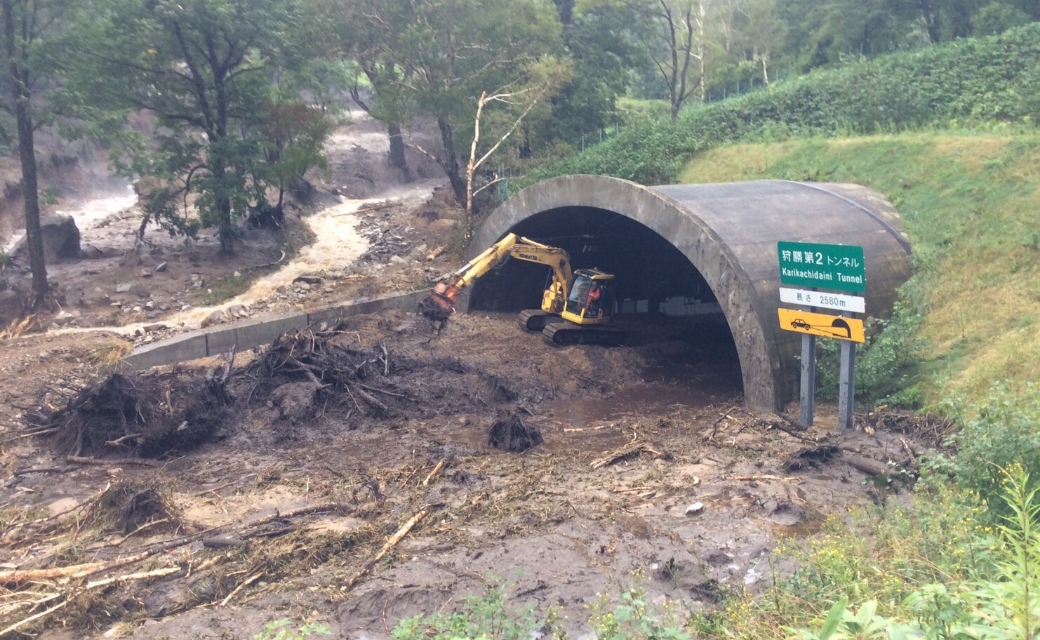
August 31, 2016 | 8:30 AM |Restoration work near the Obihiro-side entrance of the Karikachi Second Tunnel
In cooperation with all relevant parties and partner companies, we worked around the clock to carry out emergency repairs, and as a result, the road closure was lifted at 8:00 AM on September 1st, with restoration completed in approximately one day.
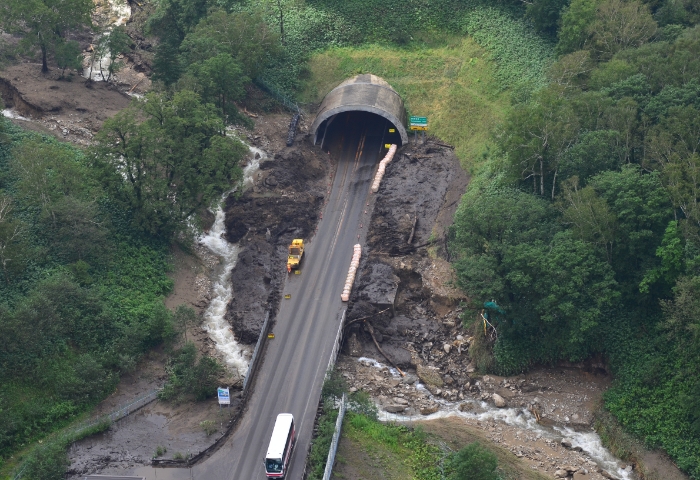
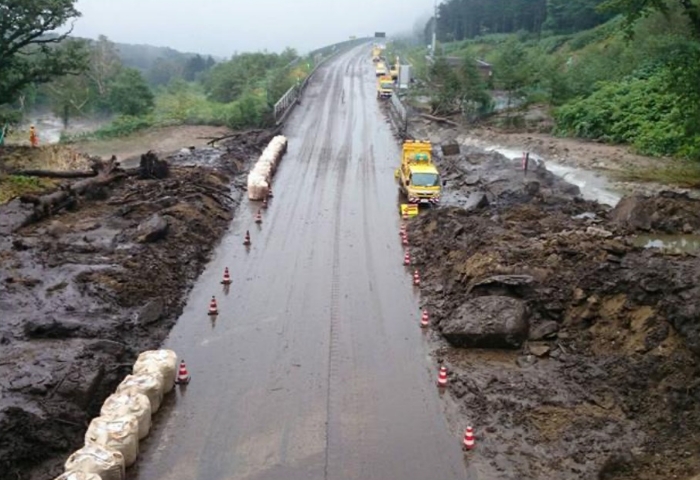
September 1, 2016 | 8:00 AM |Road closure lifted near the Obihiro side entrance of the Karikachi Second Tunnel.
As a path of lifeSediment control dam Maintenance
The cumulative rainfall from Typhoon No. 10 in 2016 reached 380 mm over three days, which is equivalent to 40% of the annual rainfall.
Due to the heavy rain, a large amount of debris flowed onto Expressway from a stream running through the nearby steep mountainous area near the Obihiro-side entrance of the Karikachi No. 2 Tunnel.
Emergency measures were taken, and the road closure was quickly lifted about a day after the disaster occurred. However, it was also urgent to implement permanent measures, so a permeable type, similar to those seen in nearby mountainous areas, was developed.Sediment control dam We decided to build it.
A weir is a structure similar to a dam but without a water storage function, and is permeable.Sediment control dam The structure has the characteristic of allowing the stream to flow normally without obstruction, while damming up large debris flows during disasters. Furthermore, since the stream that caused the debris flow is also a water source for Shintoku Town and is an essential water source for the lives of the local people, measures were also taken to prevent water from becoming turbid.
In 2021, five years after the typhoon disaster, a structure measuring 130 meters in length was discovered.Sediment control dam With its completion, the lifeline has been strengthened as a more robust infrastructure.
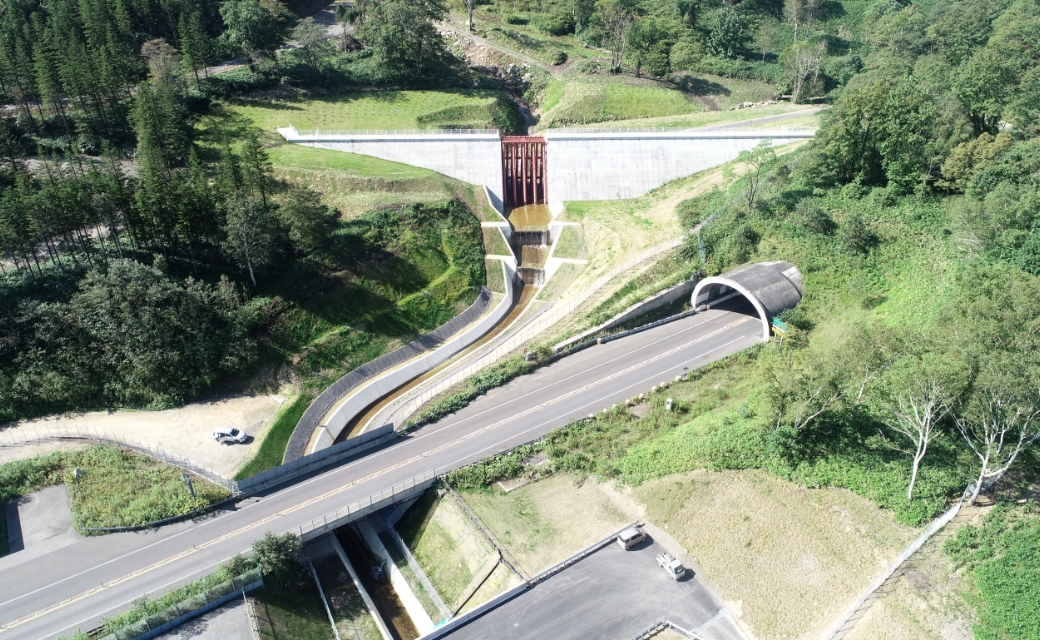
Near the Obihiro side entrance of the Karikachi No. 2 Tunnel as of September 2021
Toll-free measures ensure Doto Expressway fulfills its role as a "lifeline."
Due to the effects of Typhoon No. 10, National Route 274 (Nissho Pass) experienced bridge collapses, damage to covered roads, and embankment collapses, requiring a long period of time for repairs.
During that time, Doto Expressway was made toll-free from September 1, 2016 (Heisei 28), between Shimukappu IC and Otofu-Obihiro IC, and from October 14 of the same year, between Shimukappu IC and Tokachi-Shimizu IC, as an alternative route to national highways, etc. For approximately 1 year and 2 months until October 28, 2017 (Heisei 29), Doto Expressway became the only transportation route connecting central and eastern Hokkaido.
As a result, Doto Expressway played a vital role as a "lifeline" in supporting logistics between eastern and western Hokkaido, as well as in promoting regional healthcare and tourism.
Typhoon damage situation in August 2016 and the status of securing key routes connecting central and eastern Hokkaido.
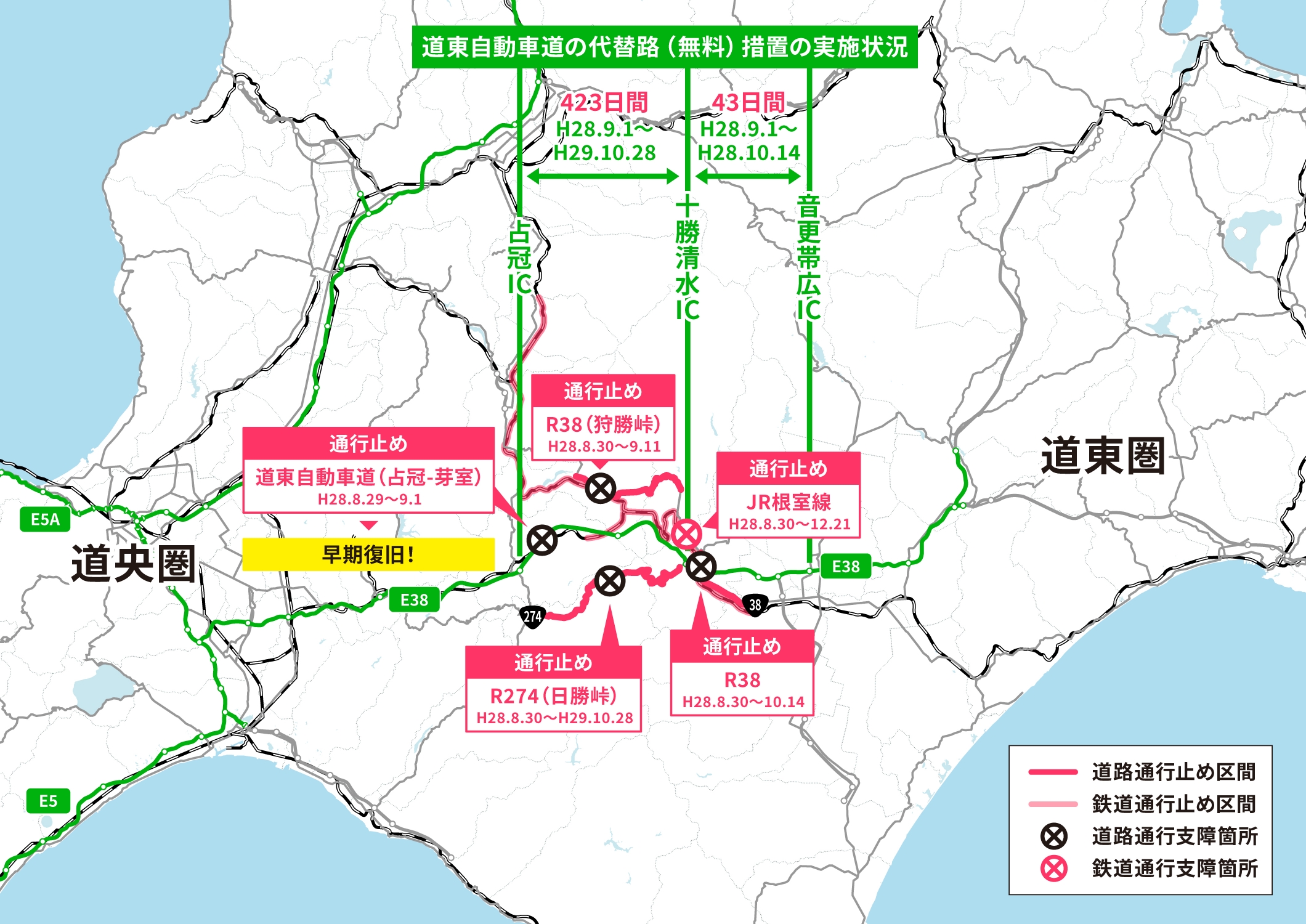
The expansion of Doto Expressway to four lanes is progressing, spurred by the damage caused by the typhoon.
Following the damage caused by Typhoon No. 10 in 2016, the need for four lanes on Doto Expressway connecting Central and Eastern Hokkaido was reaffirmed.
The importance of Expressway as a multiplicity or reserve function was emphasized to ensure that the transportation network between Central and Eastern Hokkaido does not become dysfunctional, as it served as an alternative route to the national highway. Such substitutability and reserve functions are called redundancy, and the four-lane expansion of Doto Expressway is expected to lead to improved redundancy.
In addition, the government has released the "Basic Plan for Safety and Security at Expressway" at 2019, and in Hokkaido, Doto Expressway Chitose Eniwa JCT to Tokachi Shimizu IC, between Yakumo IC and Kunisaki IC, between Date IC and Noboribetsu Muroran IC, and between Wassamu IC and Shibetsu Kenbuchi IC were selected as sections where four-laning is prioritized.
Since then, four-lane expansion projects have been initiated in the following sections.
- A section of the Tomamu IC to Tokachi Shimizu IC (approximately 9.5 km) in March 2019.
- March 2020, between Shimukappu IC and Tomamu IC (approximately 19.9 km)
- A section of the Tomamu IC to Tokachi Shimizu IC (approximately 3.2 km), including the Karikachi No. 2 Tunnel (2,576 m), was closed in March 2021.
- A section of the Tomamu IC to Tokachi Shimizu IC (approximately 5.9 km) in March 2022.
- A section of the highway between Oiwake-cho IC and Yubari IC (approximately 4.1 km) will be closed in March 2024.
This four-lane expansion project will significantly improve the safety and transport capacity of the Doto Doto Expressway, and will also contribute to strengthening future disaster countermeasures.
We will continue to support Hokkaido's transportation and logistics infrastructure by developing a safe and secure road environment.