Carbon Neutral

Promoting carbon neutrality

In order to sustainably fulfill our mission of supporting society through Expressway, our group has formulated the "NEXCO EAST Group Carbon Neutral Promotion Strategy" and is working towards achieving carbon neutrality by 2050.

NEXCO EAST Group Carbon Neutral Promotion Strategy

Concept and goals of this strategy

NEXCO EAST Group has planned reduction measures for its supply chain emissions (calculated based on the Basic Guidelines for Calculating Greenhouse Gas Emissions Throughout the Supply Chain published by the Ministry of the Environment), which include emissions from its own business activities (Scope 1 and Scope 2) as well as indirect emissions from its own business activities (Scope 3), and has set a goal (see diagram below) to achieve carbon neutrality by 2050.

Scope 1 / Scope 2
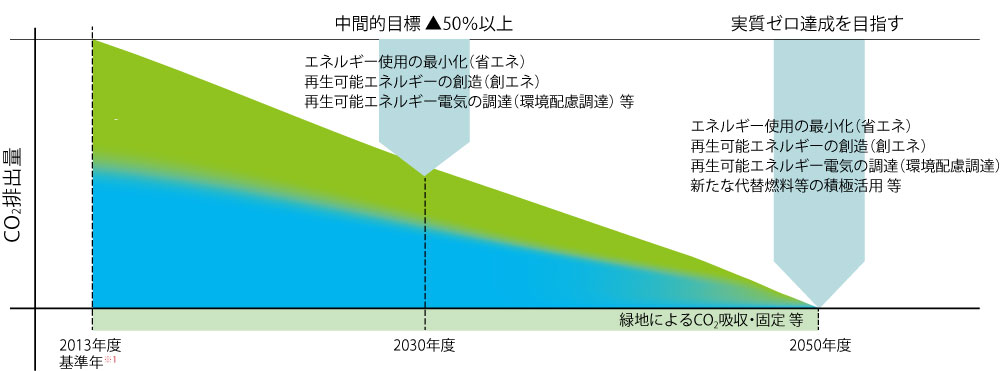
We plan and promote measures to reduce CO₂ emissions from our activities, aiming to achieve net-zero CO₂ emissions by fiscal 2050. As an intermediate goal, we aim to reduce CO₂ emissions by more than 50% by fiscal 2030 compared to fiscal 2013.

Scope 1/Scope 2 image
Scope 1/Scope 2 image (Large)

Scope 3
Aiming to achieve the government's goal of achieving carbon neutrality by 2050 and the target for fiscal 2030*2, we will promote measures that contribute to reducing CO₂ emissions from automobiles traveling on Expressway and from construction work procured for the construction and management of Expressway.

  1. This strategy will comply with the Global Warming Countermeasures Plan (Cabinet decision of October 22, 2021), and will monitor the reduction rate based on emissions in fiscal 2013.
  2. The Global Warming Countermeasures Plan sets targets for greenhouse gas emissions and absorption. The target and guideline for fiscal 2030 is a 46% reduction compared to fiscal 2013 (with further challenges aimed at reaching 50%), with targets and guideline for each sector set at a 38% reduction for the industrial sector, a 51% reduction for the commercial and other sectors, and a 35% reduction for the transport sector.

Supply chain emissions status (comparison between base year and FY2023)

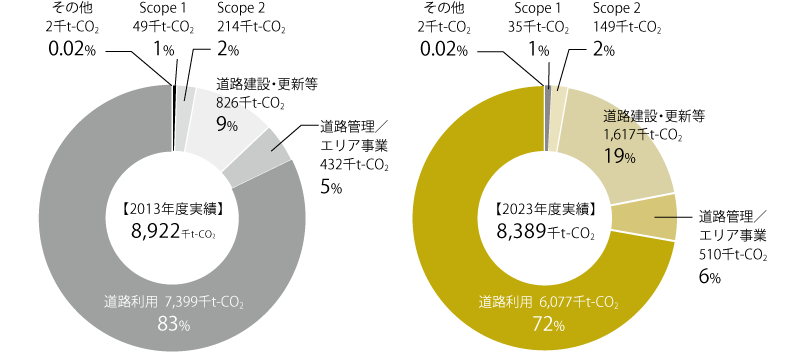
The Group's actual supply chain emissions from its business activities in fiscal 2023 will be approximately 8.39 million t-CO₂, a reduction of approximately 6% compared to the supply chain emissions in the base year of fiscal 2013.

Target year Scope 1
Emissions from fuel consumption
Scope 2
Emissions from electricity use
Scope 3
Emissions from construction, road use, etc.
Total
2013 49 (0.6%) 214 (2.4%) 8,659 (97.1%) 8,922 (100.0%)
2023 35 (0.4%) 149 (1.8%) 8,206 (97.8%) 8,389 (100.0%)
Reduction rate compared to 2013 (▲30.0%) (▲30.5%) (▲5.2%) (▲6.0%)
  • The supply chain emissions covered are Scope 1 (fuel use), Scope 2 (electricity use), and Scope 3 (emissions from construction work procured for the construction and management of Expressway and from vehicles traveling on Expressway).
  • For more information on our efforts to reduce CO2 emissions and environmental measures on Expressway, please see our corporate website and NEXCO EAST Report.

Promotion structure of this strategy

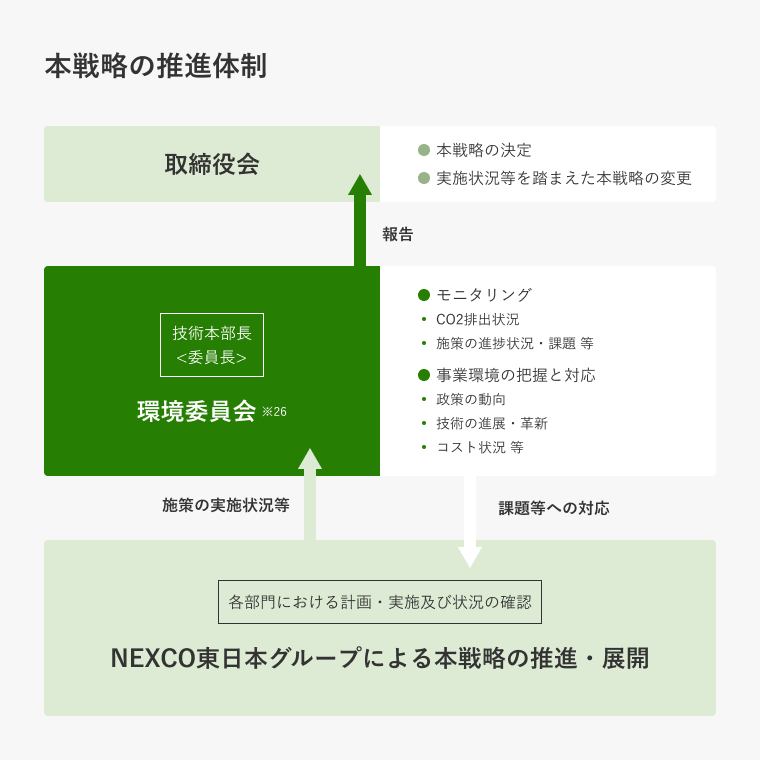
  • To promote this strategy, the company's permanent Environmental Committee will continuously monitor the status of CO₂ emissions in the supply chain and the implementation of measures, as well as understand and respond to the business environment, and report the results to the Board of Directors.
  • Furthermore, if a review of this strategy is necessary due to monitoring or the state of the business environment, the Board of Directors will make such changes.

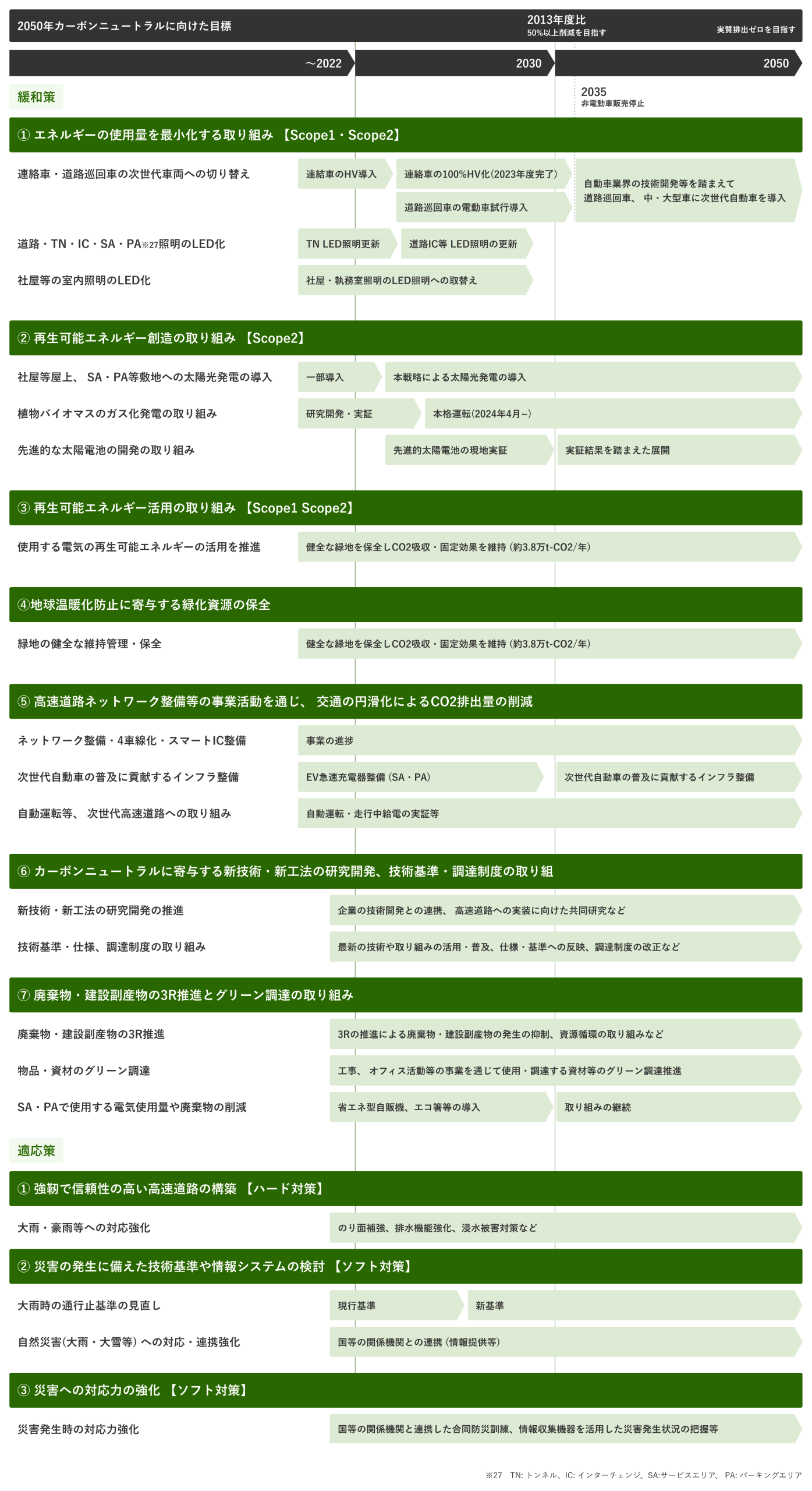
Roadmap to carbon neutrality

Image of the roadmap towards carbon neutrality
Image of the roadmap towards carbon neutrality (Large view)

Sustainability Policy and Initiatives

Indicators and Goals

Environmental

The Group is steadily advancing each of its businesses, promoting measures to ease congestion and develop Expressway networks based on the key priorities of its medium-term management plan, and working to promote the use of Expressway, which it believes will contribute to reducing CO2 emissions from automobile traffic overall.
Furthermore, in order to implement sound and effective environmental management, we have acquired ISO14001 certification, and have set short-term environmental targets and action plans, such as reducing lost time due to traffic congestion countermeasures, and by implementing the PDCA cycle, we aim to achieve our goals by improving environmental performance as an organization and complying with laws and regulations.

Key priorities in the medium-term management plan

Items Content
Strengthening Expressway network functions <New section>
Higashi-Kanto Expressway (Itako Interchange (hereinafter referred to as "IC") to Hokota IC), etc., approximately 85 km
  • Promoting the development of approximately 240 km* Ken-o Expressway (Kuzen Shiraoka Junction (hereinafter referred to as "JCT") to Daiei JCT), etc.
Ensuring punctuality by taking measures against congestion <Planned location for base maker lights to be installed>
  • In-bound Joban Expressway (Nagareyama IC to Kashiwa IC)
  • 首都圏中央連絡自動車道 内回り(狭山日高IC~入間IC)
Preparation of quick chargers for EV shift <EV quick chargers within our jurisdiction>
Cumulative total of 337 units
  • This is an extension of the development that was underway as of the end of the current consolidated fiscal year, and the development will not be completed during the medium-term management period.

- Changes in the cumulative number of quick chargers installed

year number of words
2021 156
2022 183
2023 221
2024 283
2025 337